1 June 2003
‘In 1893 Frederick Douglass, then envoy to Haiti, said he felt compelled to defend Haiti against the prejudices of ‘newspaper correspondents and six-day tourists’ by pointing out that Haiti seemed capable of enduring crisis without ‘falling to pieces and without being hopelessly abandoned to barbarism’.
Not much has changed… Laced with racism and condescension corporate media reports depict Haitians as failures at democracy and incapable of running their own country. Just as in 1990, when President Jean-Bertrand Aristide was first elected, there is now a concerted campaign to destabilize, isolate and financially starve the Haitian government.’ http://www.peacehost.net/EPI-Calc/haiti2.htm
Whilst the US tells the world of its desire to see freedom and democracy in Iraq, it’s busy starving Haiti, the poorest country in the western hemisphere into submission by enforcing a complete embargo on economic aid through its control of the IMF, World Bank and the International Development Fund, unless the Aristide government bows to US pressure to ‘reform’. In all, the US is blocking aid totaling $500 million. The US is backing a coalition of tiny, right-wing parties, the Democratic Convergence, which has links to US right-wing organisations and big business interests in the Haitian economy and which has according to reports, millions of dollars of funding from, you guessed it, the National Endowment for Democracy.
‘In January 2001, Ira Kurzban, the Aristide administration’s general counsel in the U.S., claimed that the IRI facilitated the allocation of $3 million of NED funds to the [Democratic] Convergence. Shortly thereafter, in a February 2 article, The Washington Post substantiated the IRI’s connection to the origins of the Convergence. In effect, the IRI has arranged for the Convergence to have a de facto veto power over Aristide’s constitutional mandate.’
(US) Business as usual
The history of Haiti in the 20th and 21st centuries is a typical story of US imperialism in action. Indeed, as I did my research on this article, the same names, the same structures, the same strategies scrolled down the screen of my powerbook with boring predictability: USAID, National Endowment for Democracy, the IMF, the World Bank, the IDF, plus a gaggle of structures set up to implement ‘regime change’ in this poverty-stricken island: the Haiti Democracy Project (with links to many of the organisations named here, as well as the usual assortment of US ambassadors current or former, US senators, congressmen and businessmen), the Center for International Private Enterprise (CIPE) (an adjunct of the US Chamber of Commerce) and which is funded by the usual suspects, USAID, IBM, Coca-Cola, RJ Reynolds Tobacco, the National Endowment for Democracy, Center for Free Enterprise and Democracy (linked in turn to CIPE). All of them waiting in line, as it were to bring the ‘benefits of free enterprise’ to the island if only that damn (marxist) priest, Jean-Bertrand Aristide would get out of the way! From the Reagan years of the 1980s through to the present, the names we now all too familiar with are once more, part of the de-stabilisation programme initiated by the CIA and the National Security Council (NSC): Elliot Abrams, the CIA, USAID et al.
‘Washington, October 31. Key members of the military regime controlling Haiti and blocking the return of its elected President, Jean-Bertrand Aristide, were paid by the Central Intelligence Agency for information from the mid-1980’s at least until the 1991 coup that forced Mr. Aristide from power, according to American officials.
As part of its normal intelligence-gathering operations, the C.I.A. cultivated, recruited and paid generals and politicians for information about everything from cocaine smuggling to political ferment in Haiti, they said.
Without naming names, a Government official familiar with the payments said that `several of the principal players in the present situation were compensated by the U.S. Government.’ It was not clear when the payments ended or how much money they involved, although they were described as modest.’ — New York Times, Nov 1993.
Haiti – the first free Black republic in the Caribbean
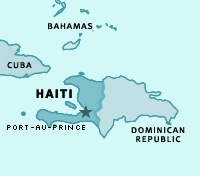
For those of you who have no idea where Haiti is or its history, Haiti occupies one third of an island in the Caribbean that used to be called Hispaniola. The other half is the Dominican Republic. Next year (2004), Haiti celebrates its 200th anniversary of independence, not that it has an awful lot to celebrate. Haiti was the first country to successfully free itself from its colonial, slave masters, the French in 1804 under the leadership of Alain Touissant, as the Caribbean’s (and the world’s) first black republic and it became a beacon for independence struggles throughout the Caribbean slave islands from that point on.
US involvement in the affairs of Haiti extend back almost 100 years:
‘The US has invaded Haiti on two previous occasions. [The first] In 1914, following disputes over the repayment of Haiti’s debt to the US, marines landed and raided the National Bank, taking the nation’s gold reserves back to New York with them.
The second invasion followed in 1915. The invasion force occupied the country for 19 years and established the basis of Haiti’s current political and economic systems. Haiti’s army was disbanded and a new army formed under US officers. The constitution was rewritten to allow foreign ownership of property.
US exports to Haiti rose from US$3.8 million in 1915 to US$15 million by 1918. The nation’s finances came under US control; even after the withdrawal of troops in 1934, the National Bank remained a subsidiary of the US Export-Import Bank.’
Although the US has always presented itself to the world as an ‘anti-colonial’ power (through exploiting its war of independence from the Brits), the reality is somewhat different as Haiti is just one of the country’s to come under the control of the US. Cuba, the Philippines, Hawaii, Panama, the Dominican Republic, Nicaragua, plus a host of small islands in the Pacific have all felt the boot of the US Marine.
Francois [‘Papa Doc’] Duvalier became president in 1957 and established a dictatorship which, with continued support from the US, lasted until 1986, his son Jean-Claude [‘Baby Doc’] Duvalier succeeding him in 1971. The Duvaliers amassed a fortune of hundreds of millions of dollars. Estimates are that up to 50,000 people were killed by the regime.
Jean-Claude Duvalier fled waves of protests and clashes with security forces in a plane provided by the USin 1986. A series of unstable regimes followed, culminating in Haiti’s first relatively fraud-free elections in December 1990, when liberation theologist Father Jean-Bertrand Aristide won a landslide victory.’ http://www.greenleft.org.au/back/1994/160/160p19.htm
Haiti — Island of Sun, Sand Sweatshops
And predicably, I came across a site http://www.bharattextile.com/newsitems/1982823 which is applauding the passing of a new US bill that permits the importing of textiles from Haiti to the US, duty-free. The site informs the reader that the average wage in Haiti is ‘$1 a day’ which even with all the other costs thrown in still totals only $2 per day. And by the strategic location of textile plants in the Dominican Republic, the two countries will be forced to compete with each other in keeping wages as low as possible.
Does your kid wear Walt Disney pajamas?
Because if he/she does, the chances are they’re made in Haiti at the US-owned plant of L.V. Miles which manufactures them under license for the Walt Disney corporation:
‘In one day [in 1996]…20 workers earn $66.60, and together they produce 1,000 pairs of pajamas. That is $11,970 worth of pajamas for $66.60. Less than seven cents per pair goes to pay the workers who produced it.’
This is from a report written by the National Labour Commission, a USNGO funded by trade unions investigating the conditions of workers in countries like Haiti. The report goes on to say that:
‘In 1994, Wal-Mart made a profit of $2.681 billion, Disney made $1.1 billion. The workers who sew the clothes for these companies are, in many cases, making less than $312 a year working full time. Basic respect for the law is not too much to ask.’
Today’s minimum wage has less buying power than before Aristide’s election in December 1990. Since 1980, its real value has declined some 50 percent. It is the lowest in the entire Caribbean area and provides less than 60 percent of the barest needs for a family of five. A more usual wage of $1 a day, or $6 for a standard workweek, provides about one- quarter of these minimum needs.
For U.S. multinational corporations, Aristide’s support for an increase in the minimum wage was a good enough reason for overthrowing him. Andrew Postal, president of Judy Bond, a U.S. women’s apparel maker with plants in Haiti, said of Aristide, ‘It was not a business-friendly government.’
The report says that after Artistide’s ouster ‘and while the Haitian military was murdering 3,000 to 5,000 people, Postal went right on producing in Haiti and exporting to the U.S. despite the OAS embargo.’ http://www.hartford-hwp.com/archives/43a/295.htmlAnd as I point out above, conditions haven’t changed in the seven years since this report was written, in fact, they’ve gotten worse with wages in real terms even lower. With the economy under total UScontrol, Haiti has sunk further and further into poverty. ‘Free market’ policies, far from creating opportunities for Haitians, has exposed them to the full force of ‘globalisation’.
The US – destroyer of the Haitian economy
Food First, a US NGO in a report identified US policies as directly responsible for the destruction of Haiti’s indigenous food production. Moreover, the Clinton administration demanded that the main condition for the removal of the military junta which had deposed Aristide’s government in 1991 was the acceptance of US-imposed conditions which included:
‘[The] eliminat[ion] [of] the jobs of half its civil servants, massively privatize public services, dramatically slash tariffs and import restrictions, get rid of price and foreign exchange controls, grant ’emergency’ aid to the export sector, reinforce an ‘open foreign investment policy,’ create special corporate courts where ‘judges are more aware of the implications of their decisions for economic efficiency,’ rewrite its corporate laws, limit the scope of state activity and regulation and diminish the power of the executive branch in favor of the traditionally more conservative Parliament.’
The Food First article continues:
‘In 1994 USAID claimed it was feeding upwards of 70,000 Haitians per day. It insists U.S. food aid is not competing with Haitian production because the food provided is not grown in Haiti. But Haitian and U.S. researchers have concluded what Food First has argued for years-that U.S. food aid is undermining local production. Massive increases in U.S. food aid drove down the prices of Haitian agricultural goods in local markets. Rice production dropped 35 percent in 1991-1992. The U.S. owned Rice Corporation of Haiti’s parent company has a virtual monopoly on rice imports to Haiti.’ http://www.foodfirst.org/pubs/backgrdrs/archive/f96v3n3.html
US covert campaigns to overthrow the Aristide government
According to information leaked to the press, from the mid-eighties onwards, the CIA has run a series of covert operations designed to sideline and isolate Aristide and to back its favoured candidate Marc Bazin. The CIA operation included a disinformation campaign that branded Aristide as mentally unbalanced,
‘The story of the CIA’s involvement in Haitian elections provides some of the backdrop for the episode earlier this month in which a senior U.S. intelligence official, Brian Lattell, characterized Aristide as mentally unbalanced. The comments were made in a closed-door briefing to member of Congress.
The CIA has made similar allegations in the past about Aristide, based on what officials say is a psychological profile of the Haitian leader. Aristide was elected Haiti’s president by a landslide in December, 1990, but was ousted in a militarycoup after serving less than a year.
The reports label the charismatic priest a violent fruitcake who has been treated in a mental hospital and has used drugs to calm his manic depression.
In a 1992 report widely circulated in Washington, Mr. Latell described a meeting with Lieut. Gen. Raoul Cedras, Haiti’s current military dictator, and praised him as one of `the most promising group of Haitian leaders to emerge since the Duvalier family dictatorship was overthrown in 1986.’
Asked last week about the CIA’s involvement in Haiti and the dispute with Congress over covert actions there, Kent Harrington, CIA director of public affairs replied, `Our comment would be no comment on this one.” http://www.fas.org/irp/congress/1993_cr/s931105-haiti.htm
‘Why is the CIA discrediting a man who is considered the Martin Luther King Jr. of Haiti, where on Dec. 16, 1990, he became the first president elected in free elections? Here is a priest who is a folk hero to Haiti’s poor, who founded an orphanage for homeless street kids, confronted the murderous Macoutes and exposed U.S. policy that propped up the hated Duvaliers.
Here is a man who speaks six languages, has a doctorate in philosophy, has written six books, composed more than 100 songs sung in Haiti and plays six musical instruments.’
Barbara Reynolds http://www.fas.org/irp/congress/1993_cr/s931105-haiti.htmThe CIA’s negative assessment of Aristide’s psychological stability complicated the Clinton Administration’s Haiti policy by giving Republicans a rationale for trying to limit the extent of U.S. support for Aristide.
‘The US had poured money into the campaign of a former World Bank economist Marc Bazin, who nevertheless ran a distant second. Bazin wanted to expand export industries and encourage foreign investment.
US money was also spent to weaken unions and the popular movements. Via the National Endowment for Democracy and the United States Agency for International Development, millions were allocated for so-called democracy enhancement.
Through the NED, the two more conservative of Haiti’s three union federations received funding. USAID opposed a minimum wage increase to 50 cents per hour with the argument that it could ‘lead to capital-intensive, rather than labour-intensive responses to opening of markets’.
In 1986, the CIA set up the Haitian National Intelligence Service (NIS), supposedly to gather intelligence on narcotic trafficking. The New York Times, however, quoted a US embassy official that the organisation ‘never produced drug intelligence’.
Patrick Elie, a drug policy adviser to the Aristide government, said that the CIA training provided to NIS agents included training for ‘wet operations’ — CIA jargon for political assassinations.
[In 1993], the New York Times revealed that many of the leaders of the coup against Aristide had been on CIA payrolls at least up until 1991.’ http://www.greenleft.org.au/back/1994/160/160p19.htm In September of 1993 the New York Times carried an article entitled:
‘Key Haiti Leaders Said to Have Been in the CIA’s Pay.’
Key members of the military regime controlling Haiti and blocking the return of its elected President, Jean-Bertrand Aristide, were paid by the Central Intelligence Agency for information from the mid-1980’s at least until the 1991 coup that forced President Aristide from power, according to American officials.The article quotes President Aristide’s spokesman as having said:
‘Given what the CIA has done in the past two weeks, namely the attempted character assassination of Jean-Bertrand Aristide, it wouldn’t be surprising to learn that the CIAhad been working with his political enemies in Haiti for many years.’
The article indicates that a member of the House Intelligence Committee confirmed the existence of payments to `* * * people in sensitive positions in the current situation in Haiti.’
Following these articles, USA Today ran an op-ed entitled, `History Repeats in CIA Smear of Haiti’s Aristide.’ The op-ed states that:
Aristide, like [Martin Luther] King is perceived as a threat to those who desire the status quo. King’s death was preceded by character assassination from U.S. spy agencies. Could history repeat itself?’
The current situation
The latest ominous development is the call, led by the Canadian government but backed by the US in the person of Otto Reich, for the removal of the Aristide government by 2004.
‘[C]ode named the ‘Ottawa Initiative on Haiti,’ wants regime change in Haiti this year before the Jan. 1, 2004 bicentennial of Haiti’s independence, says the French-language article entitled ‘Haiti to be Under U.N. Control? ‘ The group, which will next meet in April in El Salvador, has been convened by Canada’s Secretary of State for Latin America, Africa, and the French-speaking World, Denis Paradis…[and] the U.S. State Department’s ‘Continental Initiatives’ representative Otto Reich and Organization of American States (OAS) assistant secretary general Luigi Einaudi’
The ‘Ottawa Initiative,’ if true, would complement nicely the calls for Aristide’s extra-constitutional removal by the election-allergic Washington-backed Democratic Convergence opposition front. ‘It will be difficult to create the peaceful conditions necessary for the holding of credible elections in the country with Jean Bertrand Aristide in power,’ said Convergence leader Evans Paul of the Democratic Unity Confederation (KID) recently. ‘The electoral experiences with Aristide have all proven disastrous.’ Disastrous mainly because Convergence politicians remain tremendously unpopular in Haiti.’ http://www.wbai.org/artman/publish/article_62.asp
North American Racism
One undercurrent of the US/Canadian attitude toward Haiti is its racism with murmurings of upwards of 20 million Haitians by 2019 which according to the same Denis Paradis is ‘is a time bomb…which must be defused immediately’, although how invading Haiti will ‘solve’ the ‘problem’ is not stated but given the history of US and Canadian treatment of Haitian refugees fleeing the vicious military dictatorships of the past, it’s not surprising that playing the race card would be part of the campaign. The article, published in the Canadian magazine ‘L’Actualité’ quoted Denis Paradis as saying:
‘Canadians treated their animals better than the Haitian government treated its citizens, and that there was a need for international intervention to protect the Haitian people from tyranny. This so enraged Haitian public opinion and leaders that the Canadian Ambassador in Haiti denied most of the story, but L’actualité reporter Michel Vastel told me ‘every word is as Denis Paradis told me.’
But clearly, ‘regime change’ is on the cards:
‘Independent journalists and neutral political leaders, like Ben Dupuy of the respected Haiti Progres, have pointed to evidence that some opposition elements are preparing a coup d’etat. Since these groups are financed by U.S. interests, they must believe the U.S. would tacitly support such action.’ http://www.zmag.org/content/showarticle.cfm?SectionID=2&ItemID=3337
The sanctions regime is still in full force, with something like $500 million in aid still blocked by the US government and as aid constitutes 60% of the government’s budget, the sanctions are a death blow to a country which has 60% unemployment. The Aristide government which already implemented some of the privatisation and cuts in social spending demanded by the World Bank and the IMF, is under two fires; one from its population (which nevertheless still broadly supports the government) and from the Bush administration to resign. Every month the Haitian government has to pay $2 million dollars of debts incurred by previous regimes.
A ‘general strike’ earlier this year, called by the Democratic Convergence and with backing from the US government and big business including Shell and Domino Pizza, but which was not backed by the mass of Haitian people failed to have the desired effect of bringing the country to its knees.
As I write, the most pressing issue facing Haiti today is over potable water which is in extremely short supply, with the population facing a health catastrophe, but even the aid to help the Haitian government deal with this critical problem is also being blocked by the Bush administration.

 The New Dark Age
Leave a comment